Mhayer Sika
المحيّر سيكاه
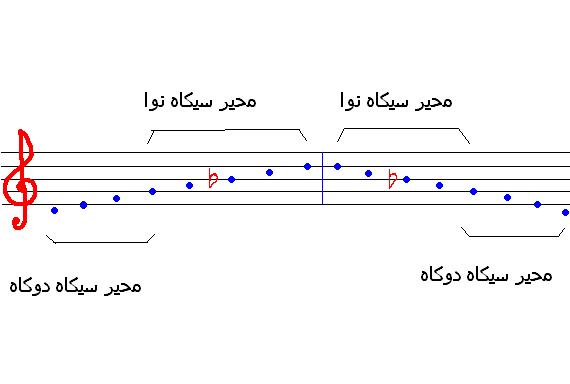
A Tunisian mode resting on dukah (D), with ʿajam as its only accidental; the eastern Nahawand is its counterpart.

Hear the scale
Press a note to hear it, or play the whole scale. Each note sits on the circle exactly where it falls in the octave, quarter-tones included.
Sing or play any note, in any octave: the needle shows where it falls in the mode. Your voice stays in your browser; nothing is recorded or sent.
Quarter-tones are placed halfway between two semitones. In performance, musicians shade them by ear.
Definition: a Tunisian mode that rests on the degree “dukah” (D).
Dukah is a Persian word meaning “second in order”; in music it is the name of the third string of the oud.
Accidentals: a single accidental, the degree “ʿajam” (B flat).
Its counterpart in the East is the Nahawand mode.
Its ajnas:
– Mhayer Sika jins on dukah, entirely without accidentals.
– Mhayer Sika jins on nawa.
Its possibilities:
– Isbaʿayn jins on nawa, using A flat and B natural.
– Isbaʿayn jins on husayni, using B flat and C sharp.
Its characteristics:
Mhayer Sika is marked by a leap of a fifth, “D … A”, especially at the start.
There is also a movement called the “mrassaʿ” movement:
it uses A flat without going into the Isbaʿayn jins,
then comes down to Mhayer Sika on dukah.